jeanpierreaubry
Hello again,
I used the third edition of Clough&Penzien.
Harmonic analysis loaded by 'base motion' gives the same resonance frequency - the peaking frequency is independent of the load type - it was not right question to take a closer look.
I came to another conclusion but trivial one: Damped modal eigenfrequency is just not close to the resonant frequency when damping ration is not close to 0.
All non-zero initial conditions provides decaying response of the system and aligned with damped modal frequency but if any driven force (as base motion or force) exists and its frequency equals modal frequency the system does not ensure its maximum response.
Here you see response of the system with a usage of DYNA_NON_LINE with non-zero initial state. The system is tensioned in z direction by 1mm and then released:
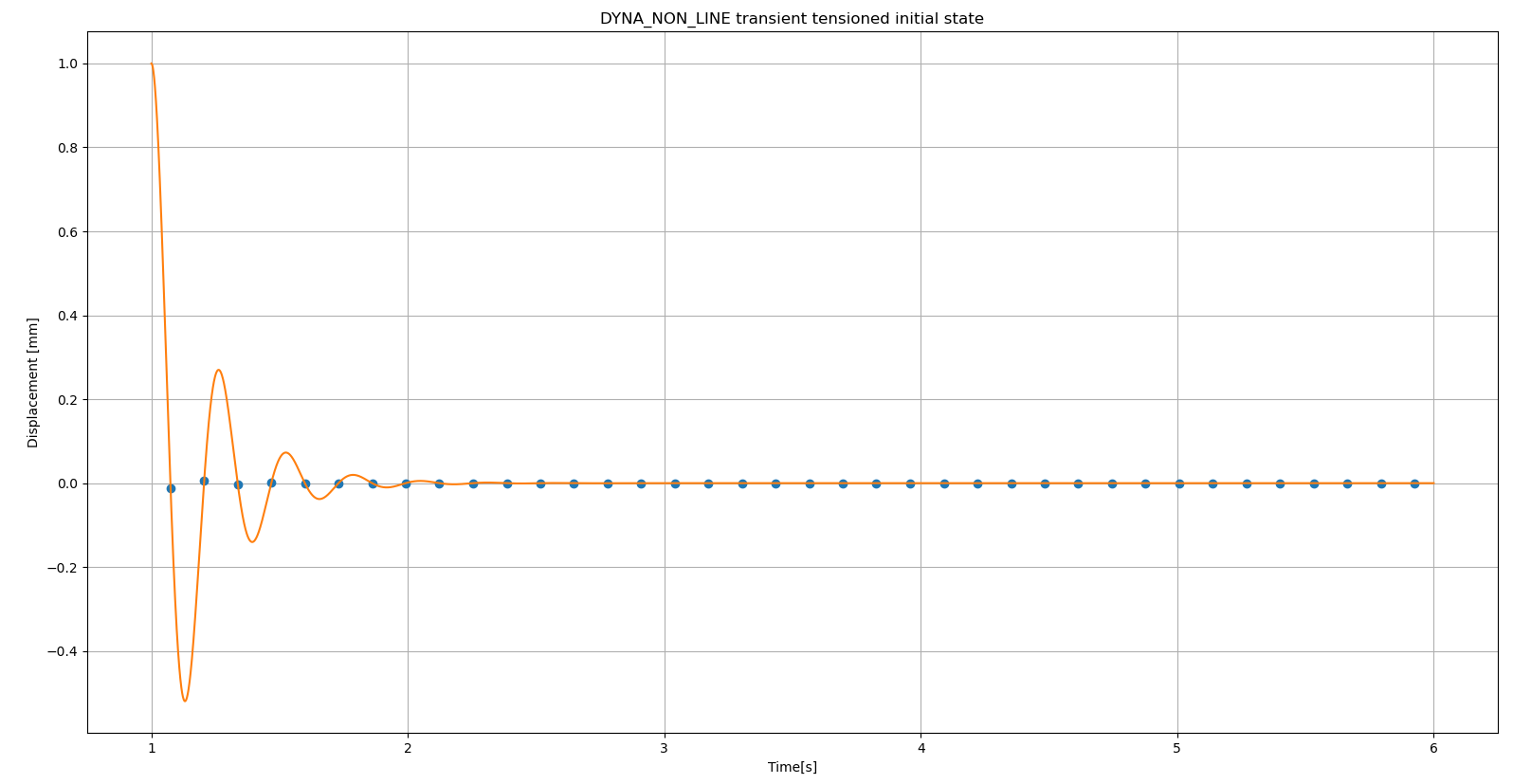
Circles mark each time-point crossing the zero displacement position - time between each consecutive circle is a real half-period of the system. By simple transformation it equals freq=3.8168 Hz (very close to the theoretical modal analysis with damping) (FFT of this signal does not provide good resolution because of short time of amplitude with relevant amplitude - that is why I count halfperiods).
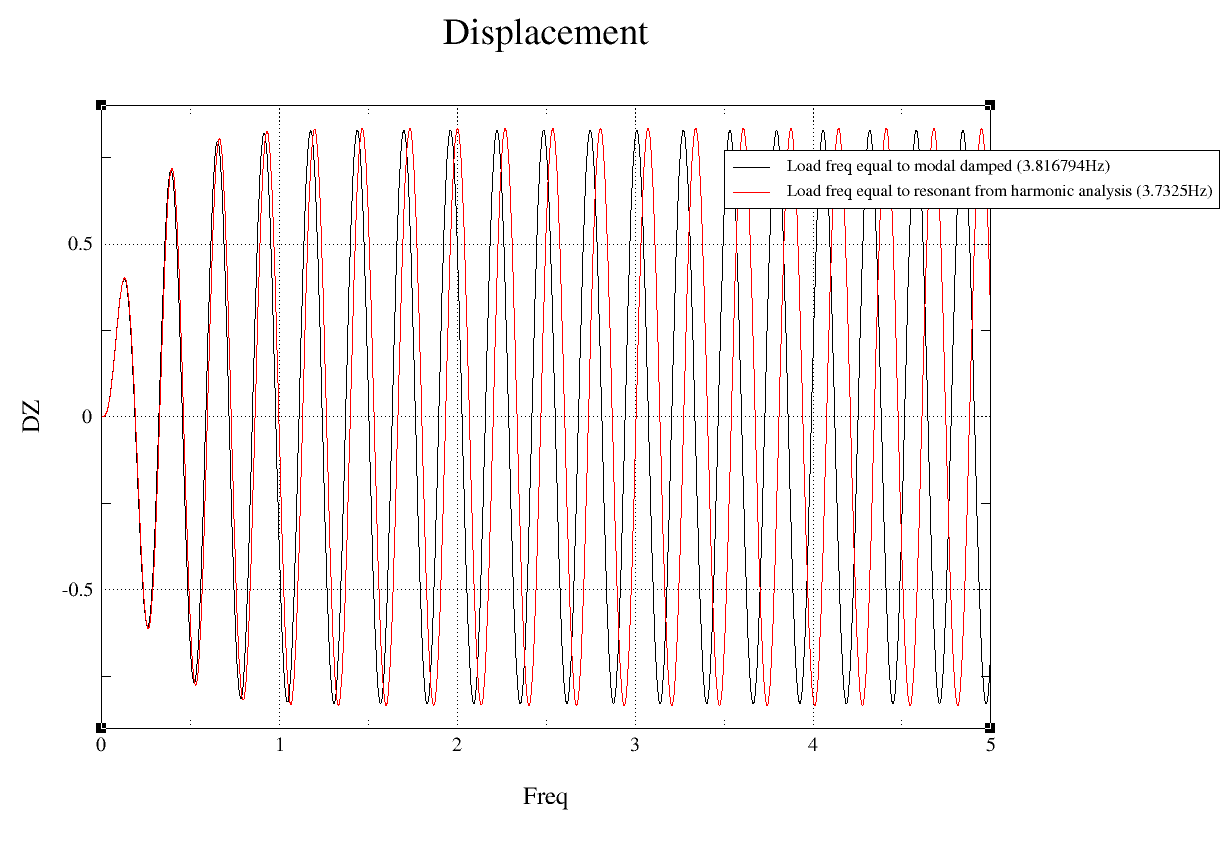
Then I made two models with a sinusoidal loads as the resonance and the modal-damped frequency and indeed the first one gives a bit higher response:
I also found a similar discusion and distinction of frequency in electrical eletrical engineering forum:
[https://electronics.stackexchange.com/questions/692613/what-is-the-difference-between-natural-frequencies-and-resonance-frequency-in-se].
To conclude:
If one is looking for the precise resonance frequency of a damped system then relying on a modal analysis (with or without damping) does not provide valid solution.
Best regards
Filip


