vishwas
I've now read through this in help docs: Instructions for using contact in code_aster
It's full of many, many caveats, application dependant and/or loads of manual trial/error loops required for difficult (real?) cases.
See the parts about meshing, and even how with high-order elems more work is required for contacts... I don't think you can chuck just any mesh at it and hope for the best, loads of testing required to como up with a planned mesh for each case.
Nevertheless, I gave the test SSNV506 a shot:
- I removed that equation in Y, makes no sense for such a simple model. It still solves, as expected. The model is driven by disps (constrained in Y) + sym planes and base constraints is enough. I called a 'cheat' (in a friendly manner, analyst's speak) coz it doesn't make for a general method. In real complex NL assys we shouldn't need those hacks on contacts.
- Without friction + NL mats (yield = 50MPa), it seems to work fine, see signed von Mises, honoring the yield around 50MPa at base solid.
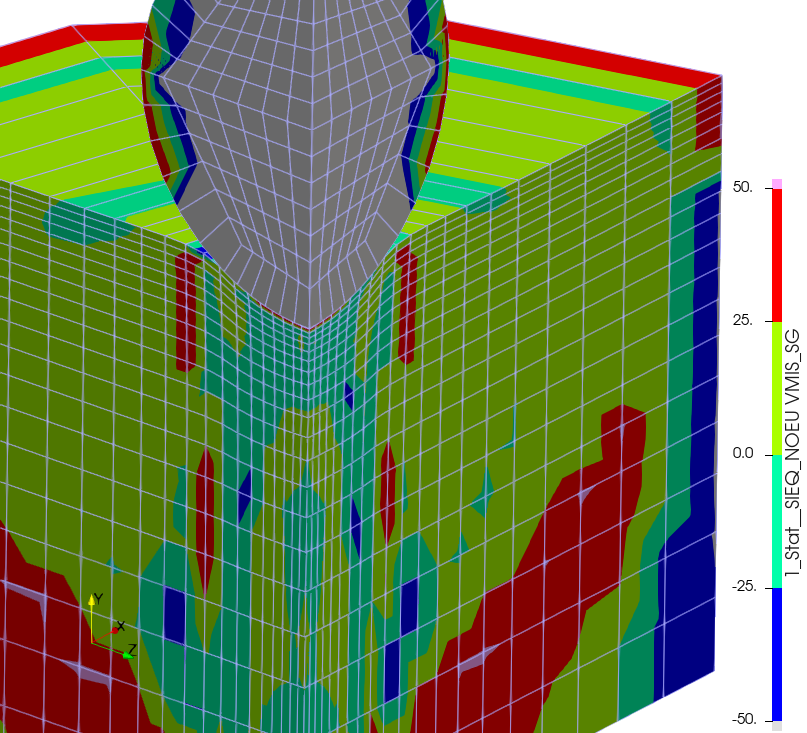
The help docs linked above recommends for friction to use the 'continue' solve method (I think?). As soon as I added friction, it doesn't solve. The num singularities I see imply that more manual work is required in the surf pairs, etc. I gave up, too much 'hacking' for such a simple example.
I think I'll just stick to all things linear in CA. I also found the NL dynamics solver with large rots, not playing ball at all w/out loads of hacking at strange modelling tricks even for a simple pendulum (see thread here).
What are your thoughts so far on all things NL in CA as a general method for 'real' assemblies?


